Wednesday, January 15, 2014

A Busy Winter for BSGSA!


Hi Everyone!

Sorry for the long hiatus from the BSGSA blog!  It has been a busy couple of months for all of us.  Here’s a recap of what we’ve been up to since November, in case you missed any of it:

November:
The holiday community outreach begins!  Kristine Moody organized a department-wide food drive to benefit Clemson Community Care (CCC), a local non-profit organization that helps support low-income families in the Clemson Area.  In the end, BSGSA and the Biological Sciences department raised enough money to donate 27 Thanksgiving turkeys and collected nearly 500 lbs of food!  What a great success!  Cheers to Kristine for putting this event together, as well as to all those to contributed by donating non-perishable goods, turkey money, and time to help deliver everything to CCC.
Loading up at Clemson.
Almost 500 pounds of food donated!
Delivering goods to CCC. 


December:
December is always a busy time around the department as the fall semester winds down.  Amidst the chaos of finalizing grades, wrapping up research projects, graduations, and preparing for mid-winter conferences, BSGSA carried out its annual Salvation Army Stocking Stuffing Project.  This year, BSGSA members filled stockings with gifts and goodies for 24 local children in need so they could have a merry Christmas. 
Christopher is excited about his stocking!
Stocking Delivery Day!

In addition, December saw the graduation of a handful of BioSci Grad Students, including BSGSA members Christie Sampson and Gautam Ginjupalli­­­­.  Congratulations to all and we wish you great success in your future endeavors!


January:
Texas State Capital Building in Austin, TX. 
Happy New Year, Everyone!  We are just a couple of weeks into 2014 and already so much has happened.  First, several BSGSA members kicked off the new year by attending the Society for Integrative and Comparative Biology (SICB) annual conference, held this year in Austin, TX.  In addition to attending the conference, all participated by presenting talks and posters throughout the week:


Christopher Mayerl:  Thermal ecology of Podarcis tiliguerta (Lacertidae) across an altitudinal gradient
Eric Riddell:  High and dry: responses of evaporative water loss along an elevational gradient for two species of lungless salamanders
Kelly Diamond:  Individual variation in locomotor performance and behavior on northern curly-tailed lizards (Leiocephalus carinatus)
Sam Crickenberger:  Lower thermal tolerance of larvae and adults of the introduced barnacle Megabalanus coccopoma: implications for range limits
Sandy Kawano:  Intraspecific variation in patterns of morphological selection in the waterfall climbing goby fish, Sicyopterus stimpsoni
Vanessa Young:  In vivo femoral strains in swimming turtles: influence of locomotor medium on limb bone loading

The Blob Lab visting Kelly's poster at SICB 2014.

Congrats to all on jobs well done!  As an added bonus, two of our members were recognized at the SICB business meeting:  Sandy Kawano received a SICB Travel Fellowship to help fund her remaining research trips to the Chicago Field Museum, the Cleveland Museum of Natural History, and the Smithsonian; and Eric Riddell received one of SICB's Grants-In-Aid-Of-Research Awards to fund his ongoing field work in which he collects Appalachian salamanders for experiments to determine their capacity to acclimate to climate change.  Congratulations!!


The Clemson Rhino! (Photo credit S. Kawano)
As if the SICB excitement wasn’t enough, the BioSci department welcomed the arrival of its new rhino on January 9th!  Throughout the fall, Dr. Richard Blob and Stanlee Miller, the Clemson University Natural History Museum curator, have received several specimens of African mammals from the Museum of York County (near Rock Hill, SC), which is deaccessioning portions of its collection that are not on display.  One of these specimens is a 15 foot long white rhinoceros, which has historic ties to Clemson.  This specimen was mounted and on display at a former Burger King in Clemson for several years, before entering the collections at the Museum of York County roughly 20 years ago.  Now it has returned to Clemson, and plans are in place for it to be displayed on the first floor of Long Hall in the near future as part of our biodiversity exhibits.  In the mean time, a big thank you goes out to Dr. Steve Klaine for housing the rhino in his lab until the display case is built!  And another big thank you to Rick and Stanlee for bringing these specimens to Clemson University!

Looking Ahead:
As we look ahead, BSGSA has an exciting spring planned.  Officers will be meeting later this week to discuss plans for Graduate Student Recruitment Weekend, CBASS, and a spring retreat.  We’ll also be planning spring service opportunities, such as Darwin Week activities, BioBowl, Relay for Life, and others.  Stay tuned for more information!

Thursday, November 7, 2013

Paradise with Pleurodires

Hi Everyone! It’s my first year here at Clemson University, and while teaching and applying for grants and all that other stuff has been fun, what I’ve always been really excited for is research. Luckily, I get to start that really soon! I’m going to be doing some work on the functional morphology and ecology of pleurodiran turtles. These turtles are interesting for a number of reasons, one of which is because almost nothing is known about them, another of which is that they’re just gorgeous and fantastic animals!


Note: Those are not my fingernails,
but check out the color on the carapace!
There are two main types of turtles in the world, cryptodirans, and pleurodirans. Cryptodirans are more of your standard turtle, and the common name form them is “hidden neck” which refers to how they pull their head back into their shell. Pleurodirans, on the other hand, are known as “twist neck turtles” because they pull their head into their shell sideways, so that one side of the head is somewhat exposed! Unlike cryptodires, pleurodires are restricted to aquatic habitats, and also only live in the southern hemisphere.

I just got my first group of turtles for my PhD: 4 individuals of Emydura subglobosa, a beautiful species from Papua New Guinea and Australia. They have brilliant red carapaces (the belly part of the shell), with streaks of color across the rest of the body. Once they get used to living in Clemson, I’ll be putting them through their paces, videotaping their locomotion in both the water and on land, so they’ll be getting plenty of exercise! 


How can you not love them!?


Wednesday, October 30, 2013

Bottoms up in the Florida Keys!

As some of you may know, BSGSA member Kylie Smith has been supervising the Conservation of Marine Resources Creative Inquiry Team as they conduct their research in the Florida Keys.  Kylie and her team have been investigating the effects of parrotfish grazing on coral reefs in the Keys, as well as how competition with macroalgae affects coral cover.  Check out this great video to take a dive with the team and learn more about the project!  Cheers, Kylie, and keep up the good work!

Thursday, September 19, 2013

Happy Thursday!

http://www.flickr.com/photos/photocarat/sets/72157635660094776/

So... I am not that great at remembering to point the camera at people, but here is a link to some of the photos taken on our hike last Saturday morning so Eric and Vanessa could school the rest of us on how to find/ catch some salamanders. Considering the only salamanders I have ever seen outside of captivity were juvenile Eurycea quadridigitata (dwarf salamanders) that my herp class back in Florida spent 5 hours dip netting through sludge to find 2 individuals, I was pretty excited! We also found some Anaxyrus americanus (american toads) as well on the way back. Oh and the waterfalls were pretty sweet too! Overall the weekend was nice and relaxing and I enjoyed getting to know some of you a little better. Now back to reading about fish and writing my proposal for the NSF GRFP.


Kelly


Thursday, August 15, 2013

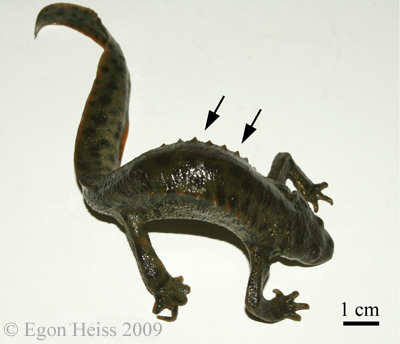
My newts shoot their ribs out of their skin?!


It's crazy that you can feel the ribs underneath the skin!
The arrows are pointing to the ribs that shoot out of small openings in the skin!

The fact that these guys shoot their ribs out of their skin as a defense mechanism is AWESOME, but that's actually not why I'm interested in them.  I'm studying Iberian ribbed newts (Pleurodeles waltl) because they are one of the largest newts (reaching almost 12 in in the wild), and are primarily aquatic.  While they can move on land quite a bit during migrations, they prefer to stay in the water.

Just hanging out before going to work!

My research involves evaluating how body morphology influenced the evolutionary invasion of land by vertebrates almost 400 million years ago, and involves using extant taxa to model the biology of fossil taxa.  Salamanders and mudskipper fishes are often used to model the earliest tetrapods and tetrapod-like fishes since they share numerous morphological, physiological and ecological similarities.  Previously, I studied how African mudskipper fishes (Periophthalmus barbarus) and tiger salamanders (Ambystoma tigrinum) moved on land, but these guys are normally pretty terrestrial (these mudskippers spend about 90% of their time out of water!  Pretty cool fish, huh?).

The fossil record suggests that tetrapods (four-legged vertebrates) evolved underwater, so our earliest ancestors were aquatic.  We have a better understanding of how more terrestrial amphibians move on land, but what about ones that are primarily aquatic?  These Iberian newts will provide us with important biological information about how primarily aquatic organisms move on land, and how their morphology helps them to accommodate the different physical demands placed by the terrestrial environment.  The data that we collect from these newts will be important in modeling the movements of some of the most important fossils during the water-to-land transition in tetrapod evolution!

Stay tuned to learn more!  

Monday, August 12, 2013

Kristine Moody creates a hominid evolution exhibit for Long Hall!

One of our BSGSA members, Kristine Moody, has been diligently working with the Department of Biological Sciences, including Stanlee Miller (Curator at the Campbell Natural History Museum), for the past several months to create an exhibit on hominid evolution, and this exhibit received its official unveiling today!  Come check it out!  Just come in through the front entrance of Long Hall, and it'll be straight ahead.

They all did a great job showcasing the sequence of events leading to the evolution of humans, and the major milestones that were associated with some of the major taxa that are on display.

Great job to Kristine for leading this initiative, and to all that helped make this happen!  Thank you for providing a really great public resource for evolutionary education!


Come learn about hominid evolution!  Curious about what we've learned from fossils?

In addition to the general information from the placard, be sure to read the informational cards for each skull!
 

Wednesday, August 7, 2013

A slippery slope with slimy salamanders

Over the past three months, I have been living in the Appalachian Mountains of North Carolina conducting research on terrestrial salamanders. It has been an incredible experience to work in this system, and I have no doubt that I work and live in one of the most beautiful places in our country. But being my first field season on this project, I had my fair share of issues. Learning how to use my flow through system to measure evaporative water loss was insanely tricky. The relationship between temperature and vapor pressure is a tricky to manipulate, sometimes with experiment-ending consequences. Miscommunications and unexpected surprises from the salamander digestive system (that's poo) also produced significant hurdles.

As of right now, it appears I will actually finish my project - at least before the first day of school. I will be honest, I have never worked this hard in my life. I sleep during the day, and at night, I hike up mountains to catch salamanders and conduct my experiments. The learning curve has been steep, as well as the mountains. I'm pretty sure I have permanent nerve damage in my big toes; I haven't felt them in a few weeks. I also had a fun trip to the emergency room at 4 in the morning to remove a moth that lodged itself next to my eardrum.

In the end, I love my project, and I am thrilled to see my first data plots and analyze my data. But I have poured almost everything I have into this project. I can't wait to return to campus and....start working again (haha).

For those of you that are close or already have finished your graduate degree, I am just beginning to understand what it takes: everything.

Thanks for letting me vent; this blog is great for that.

Time for more experiments!

Eric